Approve a light-up transporter or button-press football for reorder only when the physical sample matches the agreed written specification and design requirements. For a Chenghai toy supplier handoff, record the reviewed configuration, sample revision, decision, approver and date for each item—not one approval for the whole consolidated order. After approval, retain the identified production reference alongside the specification and change history. Release the purchase order only after its approval conditions are closed or explicitly accepted, with shipment conditions tracked separately.
The useful outcome is a record that tells purchasing exactly what to order and tells the receiving inspector exactly what to compare. A catalog description identifies the starting product; it does not approve the sample.
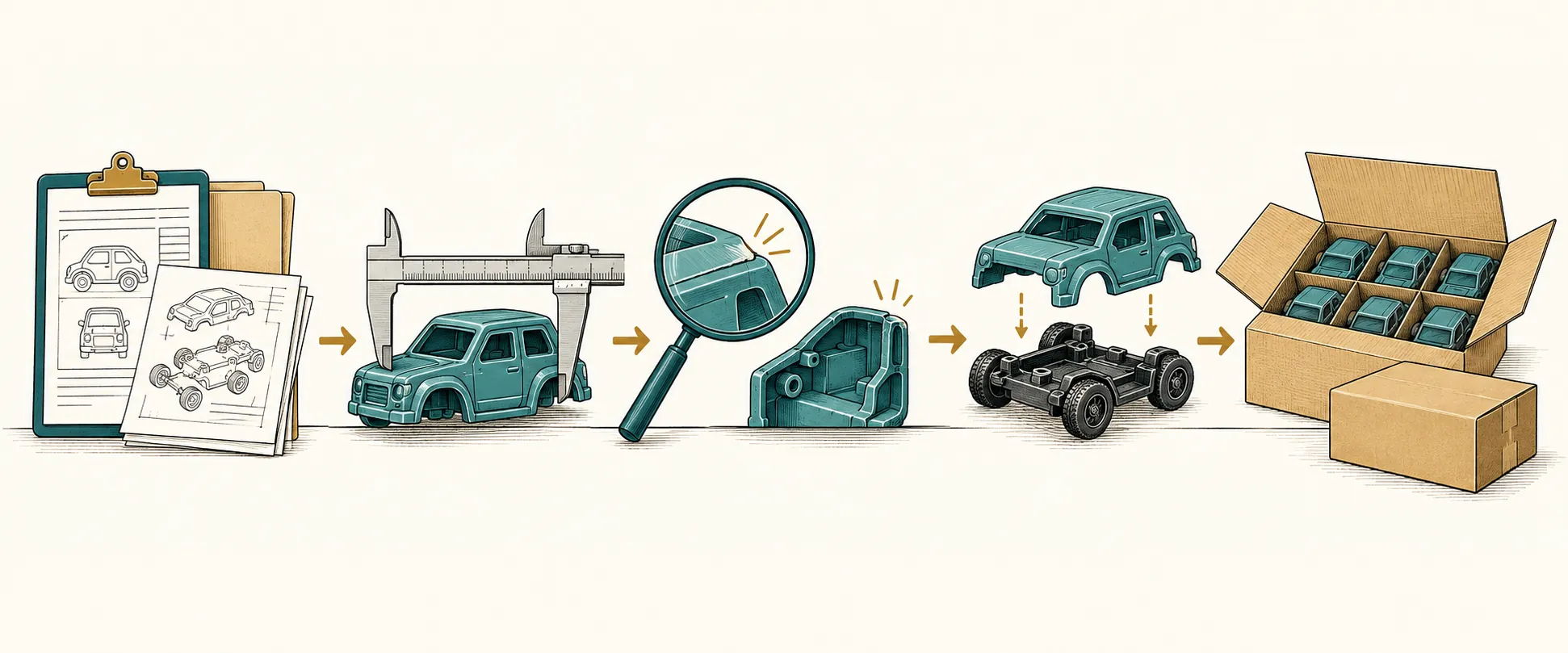
Which Catalog Details Should Anchor the Sample Review?
| Construction Vehicle Transporter Truck with Light | Recorded material: ABS. Packing entry: single item. Recorded case pack: 20 units per carton. |
|---|---|
| Button Decompression Football | Recorded retail packaging: window box. Supplier-sheet case pack: 216 units per carton. |
What Should You Inspect Before Approving the First Sample?
Compare the first physical sample with the agreed written specification and design requirements before declaring it an approved production reference.
For the transporter, activate the light using the agreed operating method and power setup. Record whether it behaves as specified, including any intermittent operation. Check wheel movement and any other agreed moving features. Count the included vehicles or accessories against the written contents list; do not infer set contents from the product name or showroom display.
For the football, operate each agreed button action and check the specified return or reset behavior. Record sticking, incomplete movement or inconsistent response as observations—not simply “function checked.” Assess whether the window box holds the toy in its agreed position without obstructing the intended presentation or controls.
Check materials against the component specification and supplier material declaration. The transporter’s ABS catalog entry is not a component-by-component material verification, and appearance or touch cannot establish resin identity. Record visible differences in color, texture, finish, assembly gaps, printing, burrs or damage against the agreed requirements.
Measure the specified dimensions at defined points and record the actual readings with units. Use agreed tolerances; any buyer-selected screening limits should be identified as purchasing criteria, not safety standards. Compare packaging format, inserts, artwork revision, barcode and label placement with the agreed packaging specification. “Single item” does not identify a particular retail box construction.
Hand inspection supports a purchasing decision; it does not establish regulatory safety or determine an appropriate age grade. Obtain the applicable laboratory evaluation for a safety conclusion rather than treating an improvised hand or pull check as a compliance test.
What Belongs in the Per-Item Handoff Worksheet?
| Item and supplier identity | Enter the buyer item ID, supplier item reference, product description, supplier name and intended assortment configuration. |
|---|---|
| Review identity | Enter the handoff record revision, physical sample identifier, submitted sample revision, inspection date and inspector’s name. |
| Specified target | Reference the agreed specification and design revision, contents list, component materials, colors, dimensions, operating behavior and packaging artwork revision. |
| Observed result | Record actual contents, measured dimensions, function results, visible finish and packaging observations against each relevant target. Identify supporting notes, images or measurements. |
| Approval decision | Select approve, conditionally approve or reject. State whether the decision covers the product, packaging, purchase-order release or shipment release. |
| Responsible approver and date | Record the authorized approver’s name and decision date. Identify a separate packaging or market-document reviewer where responsibility is split. |
| Approved production reference | After approval, identify the retained sample, its approved revision, storage location and linked specification. For conditional approval, state exactly which elements are approved and which remain excluded. |
| Current order confirmation | Attach the current quote or order confirmation covering the exact revision, quantity, assortment, price, packing format and units per carton. Resolve conflicts before releasing the purchase order. |
| Destination-market document review | Record the destination, intended use and age-grading basis, document identifiers, covered product construction, reviewer and review outcome. Keep this review separate from the physical sample inspection. |
| Open conditions and closure | For each condition, enter the discrepancy, required correction, responsible person, close-by date, release gate, verification evidence, closure reviewer and closure date. |
| Consolidation and shipment plan | Record the supplier readiness date, receiving location, inspection checkpoint, item-to-lot and carton identification, planned dispatch and action if one line remains on hold. |
| Release and reorder history | Record purchase-order authorization separately from shipment authorization. Link subsequent changes, bulk inspection results and corrective-action closure to the next reorder revision. |
How Does a Discrepancy Change the Approval Decision?
Approve a matching sample, conditionally approve only the clearly defined acceptable elements, and reject a sample whose unresolved discrepancy prevents the intended purchase.
Consider an illustrative football review—not a reported inspection result: the button action matches the agreed requirement, but the window-box artwork differs from the specified revision. Record “product function accepted; packaging not approved,” rather than approving the entire item. Assign the packaging correction to a named owner, set its due date and require a corrected packed sample or other agreed verification evidence.
If correct packaging is a purchase-order condition, hold the order until the reviewer confirms the correction. If the buyer authorizes production while packaging is being corrected, record that limited authorization and keep shipment blocked until packaging closure. Conditional approval is not permission to leave the condition ownerless.
For a transporter whose light fails the agreed operating check, record the behavior and test setup, hold approval, request correction and review the revised sample. Preserve the rejected sample’s identity and findings rather than overwriting them with the replacement result.
Close a condition only when the record contains the verification result, reviewer and date. A buyer can expressly accept a commercial deviation within their authority; that acceptance does not substitute for applicable safety requirements.
When Should You Create the Retained Production Reference?
Create and identify the retained production reference after approval, linking it to the specification and any accepted deviations.
Mark the approved sample so that the supplier, buyer and receiving inspector can identify the same configuration. Keep approved packaging and artwork references with the record, especially if product and packaging approvals occurred separately. Where useful, retain corresponding references with both the buyer and supplier.
Photographs help document appearance, but a missing photograph alone does not invalidate a review supported by identified samples, measurements and signed observations. Conversely, a photograph cannot demonstrate every functional or material requirement.
The retained sample complements the written specification and change records; it is not the only valid basis for bulk inspection. This record provides traceability. It does not, by itself, prevent an undisclosed production change.
What Must Be Confirmed Before the Consolidated Purchase Order Is Released?
Release each order line against its approved revision and current commercial confirmation, rather than carrying catalog packing assumptions into the purchase order.
Reconfirm the transporter’s recorded 20-unit case pack and the football’s supplier-sheet 216-unit case pack with the selected configuration. If the supplier confirms a different pack, reconcile the order confirmation and receiving plan before release. A carton quantity is not automatically an ordering multiple or a reason to buy surplus units.
Keep destination-market document review separate from sample observations. Ask the responsible reviewer to match document coverage to the actual construction and destination, then record the outcome. A catalog listing or document filename is not evidence that the ordered configuration has passed the necessary review.
For consolidation, give each supplier a clear receiving checkpoint and identify who authorizes dispatch. Decide in advance whether a held line will delay the combined shipment or be separated with buyer authorization. Do not allow the readiness of one supplier’s goods to become an accidental release decision for another supplier’s unresolved item.
How Should Bulk Inspection Feed the Next Reorder?
Inspect production against the approved specification, retained reference and authorized change history, then carry the findings into the next reorder decision.
At receiving or the agreed pre-shipment checkpoint, identify each supplier’s item and production lot before comparing contents, function, finish, dimensions and packaging. Repeat the transporter’s agreed light-operation check and the football’s button-action check under the recorded conditions. Use a buyer-agreed sampling plan; any chosen screening count is a purchasing control, not a safety certification or a prediction of returns.
A different included accessory, changed light behavior, sticking button or superseded packaging revision is a discrepancy to investigate. Identify and hold the affected goods, record the observed scope, assign correction and verify the corrected result before release. Expand the inspection scope when the findings warrant it; one discrepancy does not automatically invalidate every supplier’s goods.
For the next reorder, ask whether the supplier proposes any change to construction, materials, components, function, dimensions or packaging. Review those changes before ordering and obtain additional sample or laboratory evaluation where appropriate. A new internal item number or batch does not, by itself, determine whether fresh testing is necessary.
The handoff is complete when purchasing can identify the authorized revision, inspection can find its comparison records, and every remaining condition has a named owner and an explicit release gate.