Consolidate Chenghai toy orders only when each supplier’s final closed-carton data reconciles with the approved packing specification and packing list. A flying-disc launch tower and a truck-engine repair set with an RC car can share a shipment without sharing a case pack or carton design. For each Chenghai toy supplier, use proposed packing data to plan the order, then check final dimensions, CBM, counts, weights, carton strength and shipping marks before approving consolidation or keeping ready orders separate.
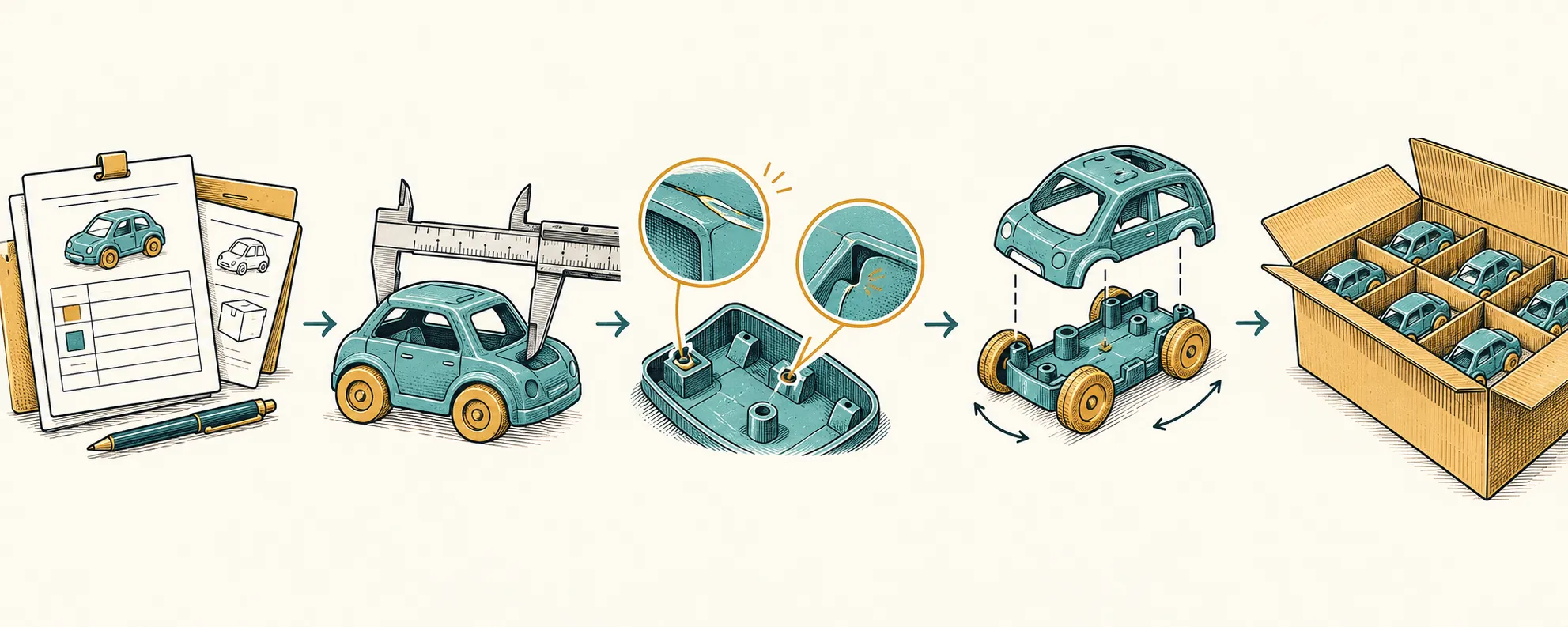
What Do the Two Product Records Establish About Packing?
| UFO Flying Disc Launch Tower Challenge Toy | Catalog reference: CHT350983. Recorded material: ABS. Packing code: C/B. Recorded case pack: 60 units per carton. Tie that case pack to the exact ordered configuration and approved packaging revision before using it for shipment planning. |
|---|---|
| Truck Engine Set with Repair Workshop and RC Car | Catalog reference: CHT217422-CHT217421-CHT217424-CHT217423. Recorded material: plastic. Packing description: single item. Confirm the exact selected configuration, retail package and master-carton case pack; “single item” is not confirmation of one unit per shipping carton. |
Which Packing Data Can Support the Order Before Final Inspection?
Use supplier-confirmed proposed packing data for the pre-PO comparison, and final packed measurements for shipment approval. Keep both versions rather than replacing the original estimate without a change record.
Before ordering, obtain an outer-carton drawing or specification showing dimensions and units, units per carton, proposed carton count, gross and net weights, carton construction, closure method and shipping-mark artwork. Identify the supplier, product configuration, approved sample and packaging revision on the same record. A retail-box size is not a master-carton size.
Once production cartons are packed and closed, record observations against that agreed target. The purchase order, packing specification and inspection checklist should reference the same revision—a practical control also recommended by Wholesale Market guide. A revision record supports traceability; it does not independently reveal an undisclosed packing change.
How Should You Inspect the Closed Shipping Cartons?
Inspect closed cartons in a fixed sequence: identify the packing configuration, measure it, reconcile quantities and weights, check packaging condition, then match shipping marks to the final packing list. Agree the inspection scope and dimensional or weight tolerances before inspection; they are purchasing criteria, not universal standards.
1. Confirm identity and packing revision. Compare carton identifiers and supplier packing records with the PO line, selected configuration and approved carton specification. An unexplained revision, substituted box or different case pack is a discrepancy. Hold the affected carton group while the supplier identifies the change; then approve the revision or require correction.
2. Measure external dimensions. Record length × width × height of the packed, closed carton in centimeters, using the agreed measurement method. Compare these observations with the approved outer-carton dimensions—not the product or retail package. Check for bulging and distinguish genuinely different carton configurations. If a difference exceeds the buyer-agreed tolerance, remeasure, recalculate CBM and review the shipment plan before deciding whether repacking is necessary. A dimensional difference alone does not make the whole shipment unacceptable.
3. Reconcile carton and unit counts. Physically count closed cartons by supplier, order line and carton configuration, then compare the tally with the packing list and approved pack-out record. Record partial cartons separately with their actual declared contents. Duplicate carton numbers, unexplained shortages or conflicting case packs require reconciliation. A sealed carton does not prove its internal quantity; unresolved content discrepancies may require a controlled count and repack, followed by updated measurements after resealing.
4. Check weights and units. Weigh the selected closed cartons on a suitable checked scale and record gross weight in kilograms. Compare it with the approved packed target and final packing list. Reconcile declared net weight with the supplier’s pack-out record; weighing a closed carton alone does not establish net product weight. An unexplained variation outside the agreed tolerance calls for investigation, not an automatic conclusion that units are missing.
5. Review carton condition and strength evidence. Check for crushed corners, punctures, moisture damage, open seams, inadequate closure and visible deformation. Compare the recorded carton construction and any agreed packaging-performance results with the approved specification. Visual inspection can identify damage, but it does not prove compression or stacking strength. Where strength is an approval condition, require the agreed test method and acceptance evidence; damaged cartons may need replacement and reinspection.
6. Match shipping marks and totals. Compare supplier or order identifiers, product references, carton numbering, quantity, weight and dimension declarations where specified, and handling marks with the approved artwork and final packing list. Check barcode readability if required for receiving. Conflicting marks or overlapping number sequences should trigger relabeling or document correction, followed by a recorded recheck before release.
How Do You Calculate CBM From Final Carton Measurements?
Calculate CBM from the external dimensions of the final closed carton, then multiply by the number of cartons with that same configuration.
Explicitly hypothetical example—not a measurement for either catalog product: a closed carton measures 60 × 40 × 50 cm. CBM per carton = L(cm) × W(cm) × H(cm) / 1,000,000 = 60 × 40 × 50 / 1,000,000 = 0.120 m³. For 20 identical cartons, total volume = 0.120 × 20 = 2.400 m³.
If those cartons instead measure 62 × 40 × 50 cm after packing, the result is 0.124 m³ each and 2.480 m³ for 20 cartons—an increase of 0.080 m³. Compare that change with the agreed tolerance and transport quotation basis before approving it; do not assume that every increase requires rejection.
Calculate each different carton configuration separately and add the subtotals. Keep palletized shipping dimensions separate from loose-carton CBM. Carton volume can erase a lower unit-price advantage, as Wholesale Market guide cautions; CBM alone, however, is not a freight quotation.
Consolidated-Order Carton Approval Worksheet
Complete one worksheet line per supplier, product configuration and carton revision, then record a shipment-level decision covering all included lines. Use “confirmed,” “to verify” or “correction required” as working statuses, with evidence attached to each confirmed field.
Identity — Worksheet ID/revision: ____; supplier: ____; PO/line and product reference: ____; selected configuration: ____; approved sample reference/revision: ____; retail-pack and master-carton specification revisions: ____.
Packing and quantity — Approved units/carton: ____; final declared units/carton: ____; full-carton count: ____; partial-carton contents/count: ____; physical carton tally versus final packing-list quantity: ____.
Dimensions and volume — Proposed L × W × H, cm: ____; agreed tolerance/method: ____; final observed measurements by carton group: ____; CBM/carton: ____; group CBM: ____; shipment CBM: ____.
Weights — Approved gross/net targets, kg: ____; agreed tolerances: ____; observed gross weights and carton IDs: ____; net-weight supporting record: ____; final packing-list totals: ____.
Strength and marks — Approved carton construction/closure: ____; required packaging-performance evidence: ____; condition observations: ____; shipping-mark artwork revision: ____; carton-number range and label check: ____.
Shipment plan — Included suppliers/carton groups: ____; receiving or consolidation location: ____; agreed readiness dates and cutoff: ____; stacking or handling restrictions: ____; separate-shipment alternative: ____.
Separate release references — Destination-specific document file/review status: ____; product-safety release reference/status: ____. Do not treat these as evidence that carton dimensions, count or strength have been checked.
Decision and closure — Approve consolidation / approve with conditions / hold / ship ready lines separately: ____; affected lines and conditions: ____; action owner and due date: ____; approver name/role and decision date: ____; correction evidence and recheck result: ____; closure approver/date: ____.
When Should You Consolidate, Hold or Ship Separately?
Choose consolidation when the included carton groups are reconciled, packaging is compatible with the agreed handling plan, readiness dates align and the current combined-shipment quotation supports the decision. Consolidation gives the buyer one combined dispatch to coordinate, but it adds a dependency between suppliers.
Keep ready orders separate when waiting for another supplier’s corrected packing data would miss the buyer’s required shipment date, or when carton handling restrictions make a shared plan unsuitable. Obtain the separate-shipment quotation rather than assuming either option is cheaper.
Hold only the affected lines when the discrepancy is confined to identifiable carton groups and the remaining order can be released independently. For example, the launch tower’s recorded 60-unit case pack is a starting point for confirmation; it does not establish the truck set’s case pack, either product’s final dimensions or their readiness to ship.
Conditional approval should name the action, owner and closure evidence. “Confirm dimensions” closes when the final packed measurements have been recorded, CBM and packing-list totals updated, and the responsible approver has accepted the result—not merely when a supplier sends an acknowledgment.
Keep product-safety testing as a separate release decision. Carton inspection checks packing condition and order conformity; it does not certify toy safety or determine age suitability. Wholesale Market guide likewise distinguishes inspection from laboratory testing.