Confirm the MOQ basis for each toy and color variant, then approve each planned color against the agreed specification before releasing bulk production. Color variants can create separate minimums for the product, color run, packaging or production batch; units per carton are a different field. For sample approval, check the physical sample against written requirements first. Only after approval should it become a retained production reference, with its color, revision and approval scope clearly identified.
The buying decision is two-part: does the exact quantity-and-color mix meet the supplier’s written terms, and does the approval record cover what will actually be produced? A carton count answers neither question by itself.
Is Toy MOQ Calculated per Item, per Color, per Package or per Batch?
Use the supplier’s explicitly stated basis—not the headline MOQ—to decide whether colors can share a minimum. Supplier guidance describes MOQ bases including item, color, package and production batch, and notes that printed packaging can have a separate minimum. These are commercial arrangements to confirm, not universal toy-industry rules. Toy wholesale MOQ
| Per item | Ask whether quantities of the same toy in different colors count toward one item-level minimum, and whether each color also has a smaller allocation minimum. |
|---|---|
| Per color | Check each color line separately. Reaching the overall item quantity does not satisfy a minimum that applies independently to every color. |
| Per package | Confirm whether different box artwork, color-specific labels or assortment packs create separate minimums. Do not assume a toy-level minimum includes every packaging version. |
| Per production batch | Ask which material, color and construction combinations count as one batch. Get written confirmation of the combinations accepted within the quoted minimum. |
| Units per carton | Use this packing quantity for carton arithmetic. It is neither the MOQ nor an automatic order multiple; confirm any full-carton-only restriction separately. |
How Much Can a Per-Color MOQ Change the Total Order?
A per-color minimum can multiply the required total even when the toy design stays unchanged. Consider a hypothetical requirement of 1,000 retail units and a proposed assortment of four colors at 250 units each. If the supplier accepts 1,000 per item with that mix, the proposal reaches the minimum. If the requirement is 1,000 per color, four colors require 4,000 units—3,000 more than the proposed total. These figures illustrate the calculation; they are not MOQ quotations for the products below.
Send one quantity line for each exact product, color and packaging revision. Also distinguish a complete colorway from the component-color assortment inside a set: changing the number of blue tiles inside one box is not the same request as ordering a separate blue-themed retail version.
Choose the shared-item route only when the supplier confirms the allocation in writing. If individual colors fall below their minimums, reduce the color count or revise quantities before approving samples. Do not silently accept a different material, finish or package merely to preserve the original order total.
How Do You Check Units, Packs and Carton Arithmetic for Each Toy?
Calculate cartons from the agreed selling unit and case pack, not from the number of components inside the toy. The 38-piece tile product and the 4-in-1 sensory set each have a supplier-sheet reference of 24 units per carton, but that shared pack quantity establishes no shared MOQ.
The following order quantities are illustrative buyer proposals. Reconfirm the current product revision, selling unit, package, case pack and MOQ before quotation; supplier-sheet packing references are not current order terms.
| 38-Piece Magnetic Building Tiles — proposed colorway A | Supplier-sheet reference: printed color box, 24 units per carton. Proposed quantity: 72 retail sets. Calculation: 72 ÷ 24 = 3 cartons. Count retail sets, not the 38 individual pieces inside each set. |
|---|---|
| 38-Piece Magnetic Building Tiles — proposed colorway B | Proposed quantity: 48 retail sets. At the same referenced case pack, 48 ÷ 24 = 2 cartons. The two proposed colorways total 120 sets and 5 cartons if each is packed separately at 24 sets per carton. Color availability and mixing terms require confirmation. |
| 4-in-1 Sensory Baby Toy Set — proposed colorway | Supplier-sheet reference: window box, 24 units per carton. Proposed quantity: 50 retail sets. Calculation: 50 = 2 × 24 + 2, meaning two full cartons plus two sets requiring an agreed packing arrangement. Do not automatically increase the order to 72 sets. |
| Electric Foam Dart Blaster — packing confirmation | The catalog reference specifies a window box. Request the current units per carton and whether cartons are single-color or mixed-color before calculating carton counts. Use the approved dimensioned specification for the sample size check. |
What Should You Inspect Before Approving the First Color Sample?
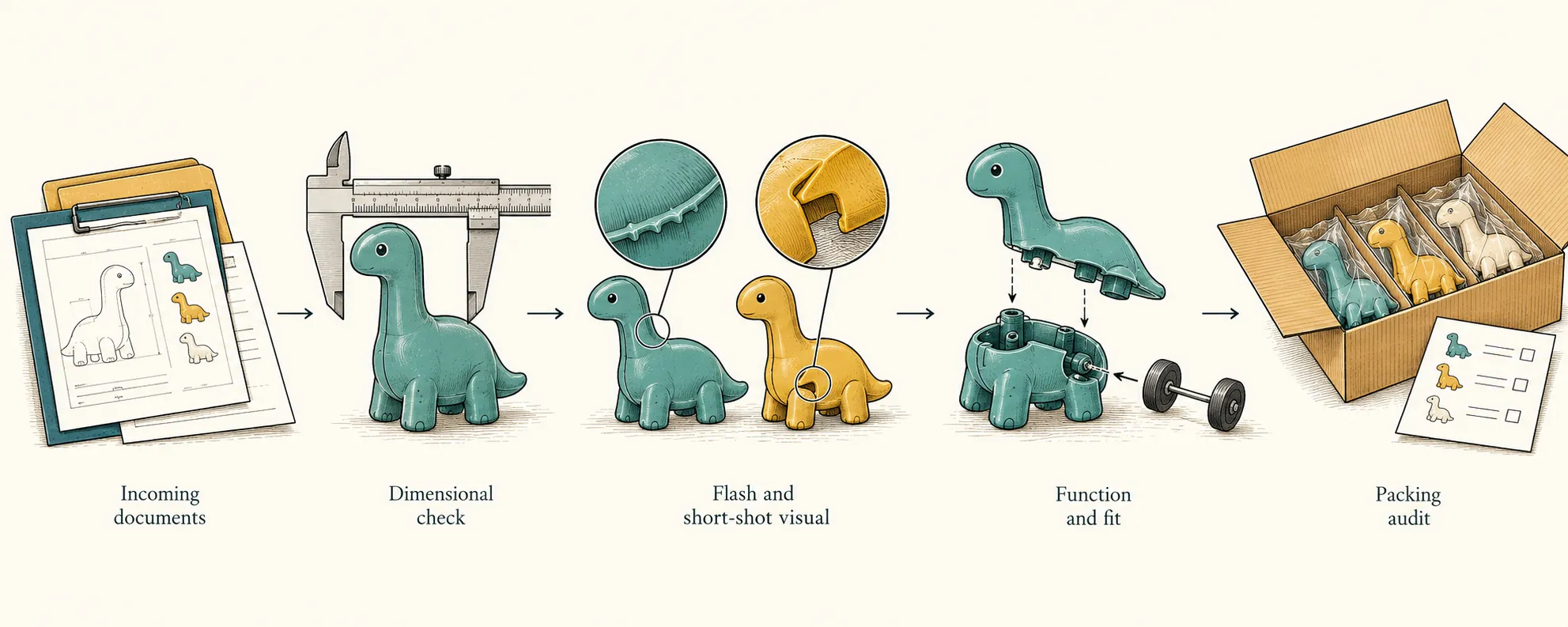
Compare the first physical sample with the agreed written specification and design requirements—not with an unapproved earlier sample. Review every planned colorway’s color-specific finish and packaging, and record which common construction and functional checks apply across the variants.
Agree viewing conditions and acceptance criteria before judging color. Use an identified physical color reference or specified color code on the intended material; photographs help document the review but should not be the sole color reference. A missing photograph alone does not invalidate measurements, written observations or other valid review evidence.
| Identity and revision | Inspect: product version, colorway, component assortment and sample identifier. Compare with: the order line, specification revision and design files. Failure signal: a different version, piece assortment or untraceable sample. Next decision: reconcile the identity before approving the affected scope. |
|---|---|
| Materials and color | Inspect: visible component selection, surface appearance, opacity, texture and color consistency. Compare with: the component/material specification and identified color reference. Failure signal: an apparent substitution, unintended color shift or inconsistent finish. Next decision: request clarification and correction; use documentation or laboratory assessment where appearance cannot establish the specified material. |
| Finish and decoration | Inspect: visible molding marks, paint coverage, print registration, logo position and unintended marks. Compare with: the finish requirements and artwork revision. Failure signal: a finish outside the agreed criteria or incorrect artwork. Next decision: identify the affected color or component and request a corrected sample. |
| Dimensions and fit | Inspect: the dimensions identified in the drawing and relevant mating or assembly features. Compare with: the dimensioned specification and buyer-agreed tolerances. Failure signal: a measured deviation or fit that does not meet the requirement. Next decision: record the target and observation, then obtain correction or an explicitly authorized specification change. |
| Function | Inspect: tile count and assembly behavior for the building set; the specified actions and included components for the sensory set; and the blaster’s instructed loading, controls and operating sequence. Compare with: the agreed function specification and instructions. Failure signal: missing components, binding, inconsistent operation or an action different from the specified version. Next decision: hold the affected function approval and review a corrected sample. |
| Packaging | Inspect: the agreed printed box or window box, insert fit, included parts, color identification, artwork and barcode assignment. Compare with: the packaging specification and approved artwork files. Failure signal: the wrong color label, component count, package version or poor fit. Next decision: correct and recheck packaging without treating an otherwise acceptable product review as packaging approval. |
Does One Sample Approve Every Color and Packaging Version?
One sample should approve only the features and variants expressly covered by its review. A blank sample can support construction and functional assessment, but it cannot establish the final logo, printed color or retail packaging. Supplier RFQ guidance makes the same distinction between blank, logo and packaging samples. Toy RFQ checklist
Use a finished sample of each planned colorway to approve its color-specific appearance. Where construction is shared, identify the common checks once and document their scope; do not copy a full approval onto an unreviewed color. Review final decorated and packaged samples for the features absent from earlier samples.
Agree the full color list before the first testing round, a planning recommendation also made in supplier guidance. Provide the intended materials, pigments, decorations and construction to the laboratory so it can assess report coverage and any additional testing needed. Do not impose an automatic rule that every new color or internal product reference requires a new test. Plastic toy specification notes
Hand inspection checks commercial conformity; it does not certify regulatory safety or determine age suitability. Keep destination-specific document review separate from the visual and functional approval, and use the applicable laboratory assessment for safety conclusions.
What Should the Color-Variant Order and Approval Record Contain?
Create one record for each product-and-color order line, linking shared specifications where appropriate. Record the required target beside the actual observation so another buyer can understand both the decision and any remaining conditions.
| Order-line identity | Record the buyer’s product reference, supplier reference, product name, colorway, component-color assortment, packaging version and order revision. |
|---|---|
| Confirmed commercial basis | Enter the written MOQ quantity, its unit and basis—item, color, package or batch—plus any subsidiary minimum. Link the supplier’s confirmation and its date. |
| Quantity and packing calculation | Enter the proposed retail-unit quantity, confirmed units per carton, single-color or mixed-color packing arrangement, full-carton count and remainder. Record an order multiple only when expressly agreed. |
| Sample identity and approval scope | Identify the physical sample, sample type, receipt date, specification revision, design revision, color reference and packaging artwork revision. State exactly which features the review covers. |
| Target versus observation | For each relevant check, record the specified target, measurement or observed result, and pass or discrepancy decision. Attach photographs where useful, along with measurement records and comments. |
| Decision and accountable approval | Record approved, approved for a limited scope, or held for correction. Name the responsible approver and approval date. State explicitly whether bulk production is authorized. |
| Open conditions and closure | Assign each correction an owner and agreed due date. Record the replacement sample or other closure evidence, recheck result, closure approver and closure date. |
| Retained production reference | After approval, identify and retain the approved sample with its revision and storage location. Link it to the governing specification, approval record and subsequent authorized changes. |
What Happens After a Color Discrepancy or Before Bulk Inspection?
Hold the affected approval scope, document the discrepancy and close it through correction or an authorized specification change before releasing that scope to production. For example, if the tile count and assembly meet the specification but one colorway misses its agreed color reference, preserve the valid findings while withholding approval of that color finish. Request the corrected color sample, compare it with the same reference and revision, and record the recheck decision.
Only after approval should the sample be designated as the retained production reference. At bulk inspection, compare production with the current written specification, approved reference samples, packaging files and authorized change records. Check color allocation and packing against the confirmed order lines as well as checking the toys themselves.
A retained sample complements the written record; it is not the only valid inspection basis, nor can a record alone reveal an undisclosed change. Reconfirm the current revision, MOQ basis, case pack and destination-document requirements before quotation, then carry those agreed details into the production release.