For US-bound Chenghai consolidated orders, advance tactile novelty toys and City building sets to a controlled document request—not a purchase release—until each selected reference has an agreed configuration, reviewed sample, confirmed case pack, approved packaging revision, market-document review and shipment plan. Target’s 2026 holiday toy edit can help frame the category shortlist; it cannot approve an item. Keep each supplier’s product file separate, then reconcile the approved references in one consolidation register before authorizing commercial commitment.
What does Target’s 2026 holiday toy edit change for a Chenghai consolidated order?
Target’s announcement supports a merchandising discussion, not a purchase authorization. On October 5, 2026, Target announced its curated 50-item Bullseye’s Top Toys list for the US holiday season. The announcement was observed on October 9, 2026; that observation date is not a supplier production or shipping deadline. Target announcement
Use the edit to decide which categories deserve a document review. Do not treat it as market-wide sales evidence, a forecast for either selected reference, permission to reproduce licensed designs, or evidence that a product meets US requirements. A Chenghai consolidation inspired by Target’s assortment is also not automatically a shipment to Target. Actual retailer instructions belong in the file only when that retailer is the confirmed receiving channel.
Which documents belong in the pre-PO handoff, and who owns them?
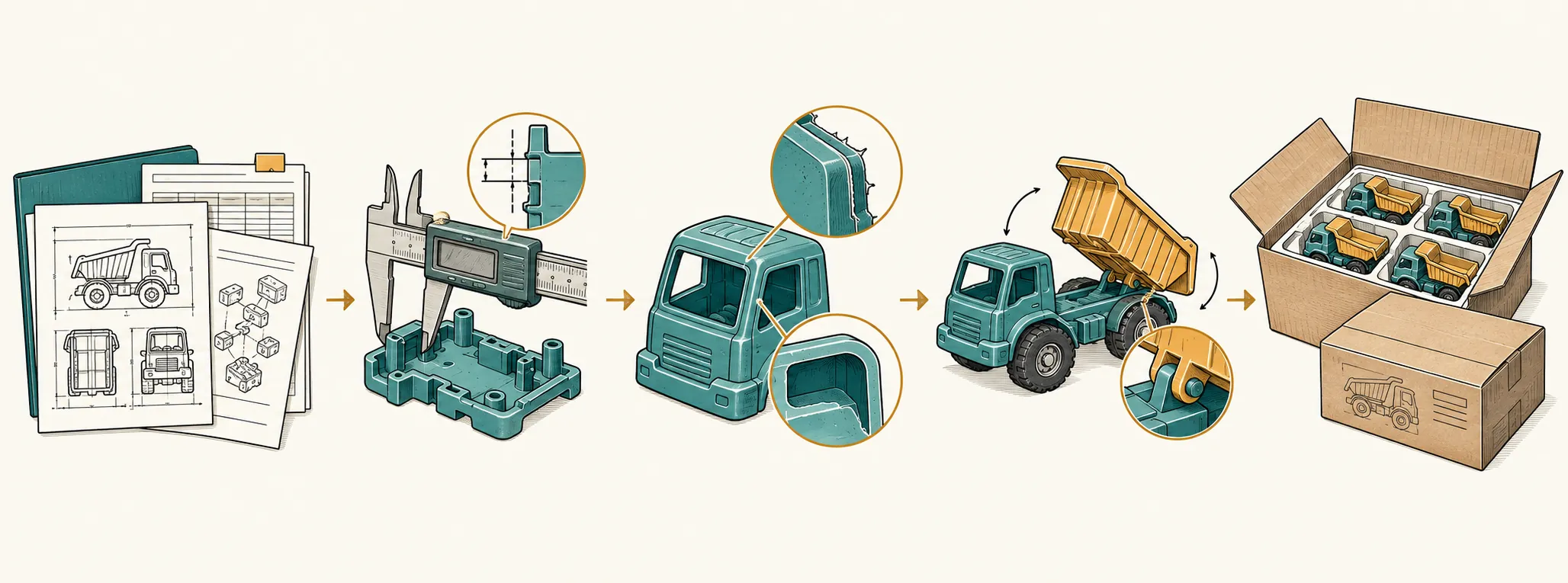
Use six linked document groups for the pre-PO review, with the current quotation attached to the product specification. These are proposed purchasing controls, not a statement of Target’s official submission requirements. Give every file a supplier identity, buyer reference, supplier model, revision and issue date so reviewers can compare the same configuration.
The owner below prepares or coordinates the document; the sourcing buyer controls the handoff decision. A mismatch should pause the affected approval and trigger a defined correction, rather than being treated as proof of dishonesty or an inevitable shipment failure.
| Product specification and quotation attachment | Owner: supplier technical contact, with supplier sales responsible for the quotation. Useful fields: exact item name, buyer reference, supplier model, construction and component list, included pieces, variants, dimensions with units, proposed age designation, quoted configuration, currency, quantity basis, MOQ unit, commercial terms and quotation validity. Mismatch consequence: the sample, quote and intended order may describe different products; resolve the difference before approving the specification or price. |
|---|---|
| Sample review record | Owner: buyer QC or the appointed sample reviewer; supplier resolves findings. Record the sample identifier, supplier model, specification revision, review date, photographs, agreed checks, observed results, deviations and approval conditions. Mismatch consequence: a sample cannot serve as the approved reference for a different configuration without an explicit review of the differences. |
| Case-pack specification | Owner: supplier packing team, checked by QC. Record retail units per inner pack where used, retail units per master carton, assortment breakdown, carton dimensions with units, net and gross weight definitions, and carton-mark revision. Mismatch consequence: carton counts, cube estimates or receiving quantities may need correction. A carton quantity does not establish an order multiple. |
| Draft packaging and labeling file | Owner: supplier artwork coordinator; buyer approves commercial content and coordinates the destination-market review. Include artwork revision, retail pack type, dimensions, product identity, quantity claims, barcode assignment, instructions, proposed age designation and warnings for review. Mismatch consequence: hold artwork approval if the pack depicts different contents, carries a different model identity or uses incompatible measurements. |
| US-market document review file | Owner: importer or designated product-compliance reviewer; supplier supplies supporting records. Record the destination and sales channel, intended age and use, construction covered, manufacturer/model cross-reference, report identifiers and dates, tested-sample descriptions and photographs, applicable requirements assessed, and reviewer disposition. Include certificates or declarations where applicable to the product and market. Mismatch consequence: refer the affected coverage question for technical review before purchase approval; document presence alone is not an approval. |
| Consolidation planning register | Owner: sourcing buyer or consolidation coordinator, with each supplier confirming its own readiness information. Before the PO, record proposed quantities, packing assumptions, collection location, requested ready date, receiving window, route assumptions, destination and file status by reference. Mismatch consequence: revise the affected plan or hold that reference rather than silently changing another supplier’s allocation. |
How should tactile novelty toys and City building sets be reconciled field by field?
Compare the specified target with an actual sample or document observation at the same packaging level. Match each selected reference to its supplier-confirmed product name before applying the tactile-toy or City-set checks below; do not infer that mapping from an internal reference number.
For commercial packing checks, SPS Commerce recommends comparing physical case quantities with approved item records and purchase orders. MOART separately identifies packaging-versus-case dimension and weight inconsistencies as a source of logistics problems. These support the reconciliation method below, not a claim that this table reproduces Target policy. SPS Commerce MOART
| Product identity and revision | Target: one agreed supplier model and configuration linked to the buyer reference. Observation: compare the specification, sample tag, photographs, quote and draft packaging. Decision: resolve unexplained differences; a different internal code alone does not establish a different construction. |
|---|---|
| Tactile novelty toy construction | Target: specify the outer material, any filling or enclosed contents, closure construction, dimensions, colors and included accessories. Observation: compare the supplier’s component description with the identified sample; review seams or closures where present and record leakage or surface-transfer observations under agreed handling conditions. Decision: refer construction differences for review. A casing-material entry does not establish the whole toy’s composition. |
| City building set contents | Target: specify the piece count, parts inventory, included figures and accessories, intended build and instruction revision. Identify lights, motors or batteries only if included in the selected configuration. Observation: reconcile the parts list, bags, instructions and sample build. Decision: correct differences between the promised contents and the supplied sample before approving the item record. |
| Sample acceptance criteria | Target: record the buyer-agreed commercial checks and acceptance conditions before review. Observation: enter actual findings against those checks, including any agreed handling or assembly procedure. Decision: accept, request correction or request another sample with reasons. Commercial sample checks are not a substitute for applicable safety testing. |
| Retail package versus master carton | Target: separate product dimensions, retail-package dimensions and master-carton dimensions, with units and measurement method. Observation: measure the identified sample pack and representative packed carton; compare net and gross weights on the same basis. Decision: correct the affected record rather than comparing a retail-box measurement with a carton measurement. |
| Case quantity and assortment | Target: state retail units per carton and the agreed variant mix. Observation: count a representative packed case and compare its contents with the approved pack specification. Decision: reconcile any difference before confirming shipment quantities; do not convert units per carton into a mandatory purchase multiple without an explicit commercial agreement. |
| Packaging identity and barcode | Target: approved product name, model cross-reference, contents statement, artwork revision and assigned barcode. Observation: compare the physical or print-proof label with the item record and check that a scanned barcode resolves to the intended item identity. Decision: correct identity or print differences before packaging release. Scannability is a commercial check, not a safety certification. |
| Market-document construction coverage | Target: supporting records applicable to the selected construction, intended use and US sales channel. Observation: reconcile model identifiers, component descriptions, photographs, age designation and tested configuration. Decision: have the qualified reviewer resolve differences and assess any additional work; do not assume a similar-looking toy is covered. |
What should the two selected-reference handoff records say now?
Route CHT350126 and CHT351000 into document collection; keep purchase approval on hold. Their exact reference identities are confirmed catalog entries. The working records below do not confirm their current configurations, commercial terms, sample results or safety-document coverage. Missing means not yet confirmed in this buyer handoff—not that the supplier lacks the information.
Complete each labeled cell separately for each SKU. Enter agreed targets before comparison; enter submitted information or measured results under Observed/submitted and identify which it is. Replace Missing with Confirmed only after a named reviewer accepts the evidence against the current revision. A submission alone is not confirmation. Assign an individual owner and due date to every open row; record the reviewer and review date when closing it.
| CHT350126 — Product configuration | Catalog confirmed: reference CHT350126. Target: [supplier model, exact product name, construction/components, included pieces, variants and specification revision]. Observed/submitted: [supplier specification and differences; not yet reviewed]. Status: Missing. Owner: [name—supplier technical contact; sales contact for quotation]. Due date: [YYYY-MM-DD]. Evidence/reviewer/date: [complete]. Attach a current quotation confirming configuration, price/currency, quantity basis, MOQ unit, terms and validity before commercial use. |
|---|---|
| CHT350126 — Sample review | Catalog confirmation: no sample acceptance established here. Target: [sample identity, specification revision, agreed checks and acceptance conditions]. Observed: [actual results, photographs and deviations; not yet recorded]. Status: Missing. Owner: [name—buyer QC or appointed reviewer]. Due date: [YYYY-MM-DD]. Evidence/reviewer/date: [complete]. Record acceptance, correction or replacement-sample conditions. |
| CHT350126 — Case pack | Catalog confirmation: no current pack approved here. Target: [retail units per inner/master carton, assortment, carton dimensions with units, net/gross weight basis and carton-mark revision]. Observed/submitted: [supplier pack specification; physical case count and measurements separately]. Status: Missing. Owner: [name—supplier packing contact/QC]. Due date: [YYYY-MM-DD]. Evidence/reviewer/date: [complete]. Confirm order multiples separately. |
| CHT350126 — Packaging | Catalog confirmation: no artwork approval established here. Target: [retail pack type, dimensions, artwork/instruction revisions, contents statement, barcode and labeling for review]. Observed/submitted: [proof or sample-pack identity and comparison results]. Status: Missing. Owner: [name—supplier artwork coordinator]. Due date: [YYYY-MM-DD]. Evidence/reviewer/date: [complete]. Reconcile the packaging with this SKU’s approved configuration. |
| CHT350126 — Market documents | Catalog confirmation: no safety or document-coverage approval established here. Target: [confirmed destination/channel, intended age/use and applicable document requirements]. Observed/submitted: [report/certificate identifiers, dates, covered construction/model and reviewer findings]. Status: Missing. Owner: [name—importer or designated compliance reviewer]. Due date: [YYYY-MM-DD]. Evidence/reviewer/date: [complete]. Resolve coverage questions for this configuration. |
| CHT350126 — Shipment planning | Catalog confirmation: no readiness or routing commitment established here. Target: [requested quantity, ready date, collection point, receiving window and route assumptions]. Observed/submitted: [supplier-confirmed production/readiness dates and routing confirmation, with source dates]. Status: Missing. Owner: [name—buyer/consolidation coordinator]. Due date: [YYYY-MM-DD]. Evidence/reviewer/date: [complete]. Keep requested dates distinct from commitments; hold unresolved mismatches. |
| CHT351000 — Product configuration | Catalog confirmed: reference CHT351000. Target: [independent supplier-model cross-reference, exact product name, construction/components, included pieces, variants and specification revision]. Observed/submitted: [this supplier’s specification and differences; not yet reviewed]. Status: Missing. Owner: [name—supplier technical contact; sales contact for quotation]. Due date: [YYYY-MM-DD]. Evidence/reviewer/date: [complete]. Confirm this SKU’s current quotation, currency, quantity basis, MOQ unit, terms and validity; do not copy CHT350126’s values. |
| CHT351000 — Sample review | Catalog confirmation: no sample acceptance established here. Target: [this SKU’s sample identity, specification revision, agreed checks and acceptance conditions]. Observed: [actual results, photographs and deviations; not yet recorded]. Status: Missing. Owner: [name—buyer QC or appointed reviewer]. Due date: [YYYY-MM-DD]. Evidence/reviewer/date: [complete]. Retain its own sample disposition and correction conditions. |
| CHT351000 — Case pack | Catalog confirmation: no current pack approved here. Target: [this SKU’s retail units per inner/master carton, assortment, dimensions with units, net/gross weight basis and carton-mark revision]. Observed/submitted: [supplier pack specification; physical case count and measurements separately]. Status: Missing. Owner: [name—supplier packing contact/QC]. Due date: [YYYY-MM-DD]. Evidence/reviewer/date: [complete]. Verify packing levels and order multiples independently. |
| CHT351000 — Packaging | Catalog confirmation: no artwork approval established here. Target: [retail pack type, dimensions, artwork/instruction revisions, contents statement, barcode and labeling for review]. Observed/submitted: [this SKU’s proof or sample-pack identity and comparison results]. Status: Missing. Owner: [name—supplier artwork coordinator]. Due date: [YYYY-MM-DD]. Evidence/reviewer/date: [complete]. Reconcile its own contents and instructions. |
| CHT351000 — Market documents | Catalog confirmation: no safety or document-coverage approval established here. Target: [confirmed destination/channel, intended age/use and applicable document requirements]. Observed/submitted: [this construction’s report/certificate identifiers, dates, model coverage and reviewer findings]. Status: Missing. Owner: [name—importer or designated compliance reviewer]. Due date: [YYYY-MM-DD]. Evidence/reviewer/date: [complete]. Assess coverage independently rather than borrowing the other reference’s disposition. |
| CHT351000 — Shipment planning | Catalog confirmation: no readiness or routing commitment established here. Target: [requested quantity, ready date, collection point, receiving window and route assumptions]. Observed/submitted: [this supplier’s confirmed production/readiness dates and routing confirmation, with source dates]. Status: Missing. Owner: [name—buyer/consolidation coordinator]. Due date: [YYYY-MM-DD]. Evidence/reviewer/date: [complete]. Compare commitments with the consolidation plan and hold unresolved mismatches. |
| Record identity — complete separately for each SKU | Record ID: [enter]. Buyer reference: [CHT350126 or CHT351000]. Supplier legal identity/model: [enter]. Destination/channel: [enter]. Specification and artwork revisions: [enter]. Add PO/line references after issue. Preserve superseded revisions and reasons for approved changes. |
| Buyer decision and hold closure — complete separately for each SKU | Initial proposed routing: release document request; hold PO approval. Actual decision: [enter]. Sourcing buyer/name/date: [enter]. Release purchase approval only when all six field groups are confirmed against the current revisions. Otherwise record each open item, corrective action, named owner and due date. Closure: [corrected revision or replacement sample, review result, closer and date]; then record the buyer’s new decision. This record aids traceability; it does not guarantee safety, compliance, customs clearance or delivery. |
Which documents should wait until after the PO or actual packing?
Final shipment documents belong after order and packing facts exist; they are not prerequisites for requesting a quotation or approving a pre-PO specification. Before commitment, use proposed quantities, a case-pack specification, draft packaging and a shipment plan with clearly identified assumptions.
After PO issue, add the order acknowledgement, approved production and packaging revisions, agreed readiness milestones and any inspection arrangements. Ask each supplier to confirm its own dates. A holiday merchandising announcement does not establish a production window, vessel availability or a guaranteed arrival date.
At the packed-shipment stage, reconcile the final packing list and commercial invoice with the actual quantities, carton marks, carton count, weights and approved PO lines. Obtain the transport documents appropriate to the agreed route and shipment. Keep supplier-level records traceable inside the consolidated shipment rather than replacing them with an unexplained aggregate total.
If the physical pack changes after approval, identify the affected fields and reopen those checks. A carton-size correction may require a logistics update; a product-construction change may require a technical coverage review. Those are different decisions.
When should the buyer release a reference, and what closes a hold?
Release a reference to the next stage only when the approval-critical fields for that stage are confirmed against the identified revision. Document-request release permits investigation; PO release approves the agreed purchasing configuration; shipment release addresses the packed order. None should be used as shorthand for the others.
For a hold, write the discrepancy precisely: for example, the City set’s instruction contents differ from the approved parts inventory, or the tactile toy’s component description differs from the sample identification. These are illustrative review scenarios, not reported defects. Assign the correction to the relevant supplier contact, identify the buyer reviewer and agree a due date. Close the hold only after the correction is checked and recorded.
For test-report questions, assess the tested construction and report scope, product changes, applicable retest duties and buyer or retailer policies separately. A later batch does not automatically require a new report, a report has no universal expiry rule, and a different internal reference does not automatically invalidate coverage.
Keep an unresolved item from blocking unrelated approvals unless a shared dependency justifies the hold. The record supports traceability and a controlled decision; it does not itself reveal an undisclosed substitution or guarantee safety, stock availability, customs clearance or delivery.