Turn a broad Chenghai catalogue into a fair shortlist by connecting visible form to a specific play action. A translucent panel that becomes a castle wall offers a different discovery from a dinosaur truck that stores and shoots cars. Give each reference a proposed collection role and one question a demonstration should answer: that is more useful than calling everything “innovative.”
The runs January 11–14, 2027, at in Wan Chai. Use Chenghai ToyHub as a discovery and sourcing desk for that visit—not as a claim of factory ownership or exhibitor status. These are catalogue references, not confirmed fair exhibits, launches or tested performances.
Where should your product-discovery tour begin?
Begin with official categories that match the action you want to examine, rather than treating catalogue order as a walking route. The lists Educational Toys & Games, Electronic & Remote Control Toys, World of Outdoor & Sporting Goods, and Festive & Party Items.
Use those categories to group construction, controlled-vehicle and bubble-play comparisons. Within each group, compare the same action across different forms: a finished building rather than loose tiles, or a driving transition rather than an attractive vehicle shell.
Keep the sensory-rattle card on a separate branch: Baby Toys & Activity belongs to the concurrent , also running January 11–14, 2027, at . That distinction gives infant handling its own visit objective instead of burying it inside a broad educational-toy search.
What makes the magnetic tiles worth examining?
Its proposed hook is to compare construction with translucent-panel appearance, keeping the supplier's component claims separate from the identified set. The CHT351372 description lists ABS shells, a colored PC-film middle layer, roof-shaped accessories and castle figurines. Those are written catalogue statements, without a counted inventory or a definition of UV in the title.
The supplier proposes three-dimensional structures and colored light patterns near a window or table lamp. At a relevant fair demonstration, compare the selected build and the role of its panels, rather than assuming every construction reference includes the described castle or painting accessories. UV in the name does not establish a UV lamp. The shortlist reason is the proposed relationship between building and appearance; the selected components remain part of the comparison.
Its listed 36 × 26 × 7 cm color box belongs to the retail-presentation discussion, not the assembled-castle measurement. Put construction and light-play on the card; make the demonstration question about which supplied pieces complete the building.
The 36 × 26 × 7 cm color box sits within a separately recorded 54 × 30 × 28 cm master of 8 sets, 21.8 kg gross/19.8 kg net. These packing figures identify the archive configuration. They do not tell you the size of a completed building or the dimensions of an individual tile, so neither should become the product's discovery headline.
Why keep sensory rattles and housekeeping play apart?
Keep them apart because grasp-and-shake exploration and acting out a household task are different reasons to shortlist. is a TPR sensory chew-rattle reference titled 4-in-1, with catalogue age fields of 0–24 months and 2–4 years. Use it to organize a handling comparison: what can be grasped, moved and shaken?
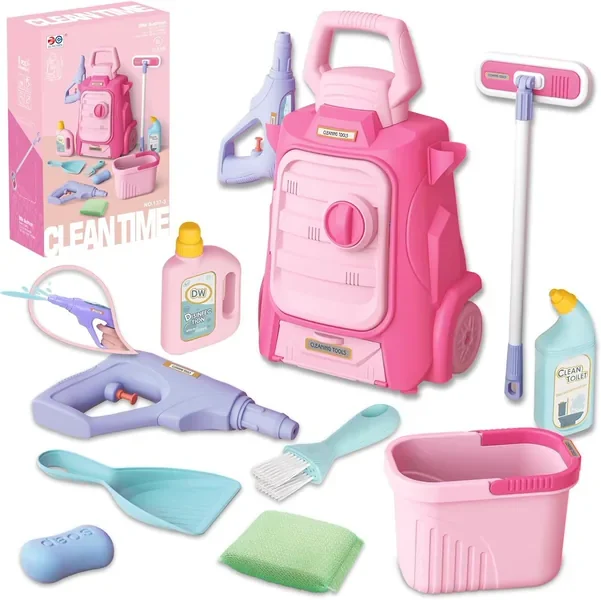
By contrast, is catalogued as an 11-piece ABS housekeeping kit. Its age field begins with a 2–3-year band and extends into older bands, so the useful fair discussion concerns the cleaning activity and intended user rather than a shared “early learning” label. Its original model field groups CHT303814 with CHT303813, without allocating a separate tool list to each. The 11-piece title is a selection cue, not a reason to assign every pictured accessory to both codes.
The housekeeping kit’s 45 × 17.5 × 28 cm measurement describes its color box, not a child-height cleaning station. Look for a coherent sequence involving the accessories: a role-play collection needs an activity to merchandise, not simply a collection of objects.
The actual housekeeping graphic shows a pink wheeled cleaning case, vacuum-shaped parts, a mop-like tool, bucket, brush, dustpan, sponge and bottle shapes. That gives the display a put-away story as well as a cleaning story: the collection can be examined through choosing, imitating and returning tools. The image does not prove suction, a liquid cleaner or the precise 11-piece accounting. Its 73 × 47 × 87 cm master holds 12 units and records 19.3 kg gross/16.3 kg net, separate from the retail scene.
For the rattle reference, 4-in-1 is title wording, not an enumerated four-item inventory. The 96-per-carton field is a shipping count, without an individual rattle count. Keep its TPR material statement and supplier age bands as catalogue fields; neither establishes independent chew suitability or developmental benefit. A sensory handling comparison and a housekeeping sequence therefore remain separate decisions.
What separates the dinosaur truck from the stunt car?
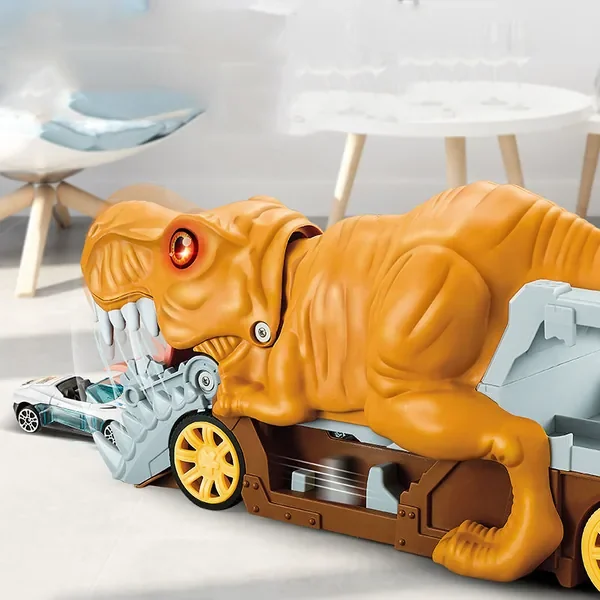
The dinosaur truck invites a loading-and-shooting investigation; the stunt car invites a controller-and-movement investigation. combines car storage with a listed shooting function in an ABS-and-metal transport truck. Follow how the storage opening connects to the release action rather than stopping at the dinosaur silhouette.
Its battery field lists 3 AG13 cells without assigning them to a function. Build that into the demonstration agenda: trace the loading-to-shooting sequence and identify where powered effects enter it.
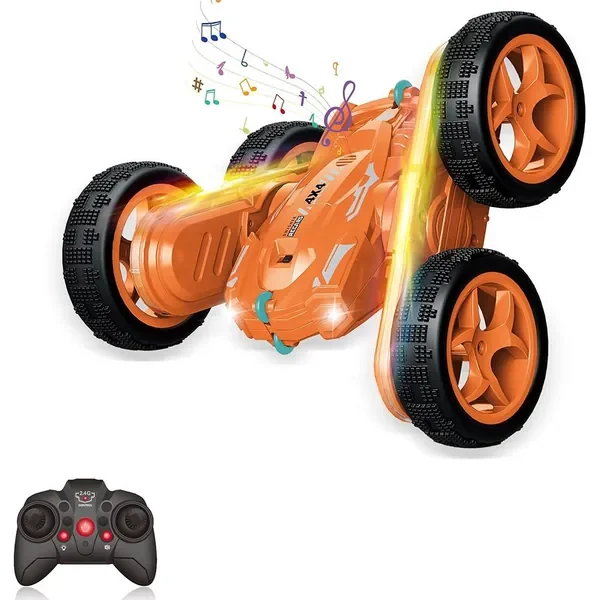
instead lists 2.4 GHz control, 4WD, a double-sided body and 360° rotating flips. Its 15–20 m remote-distance figure is a supplier statement, not a fair-floor operating requirement or a tested range. The useful comparison is the actual command and response when the selected car changes running sides.
The RC record lists ready-to-go assembly, AA controller batteries, and batteries plus a USB cable in the package-includes field. Examine the controller, vehicle and charging connection together; the shortlist reason is how the user directs the action, especially when changing running sides.
The dinosaur image shows an orange head at a car-loading opening, with a small car partly inside. It makes the storage theme visible, without demonstrating a launch or proving that the mouth supplies the shooting action. The stunt-car graphic shows orange wheels, a separate controller and light/music graphics. Compare those pictured propositions with the selected samples; do not infer a complete command map from the controller's appearance.
Why look beyond the bubble machine’s lights?
CHT323717 deserves attention for its standing format, because placement changes the play setup more distinctly than decorative lighting alone. The PP machine lists a 20 × 20 × 118 cm product size, a wide round base and 3 height settings.
The operating description includes LED light, music and one-button operation, powered by 3 AA batteries that are not included. For an outdoor or party collection, investigate how the height positions change where bubbles enter the surrounding activity.
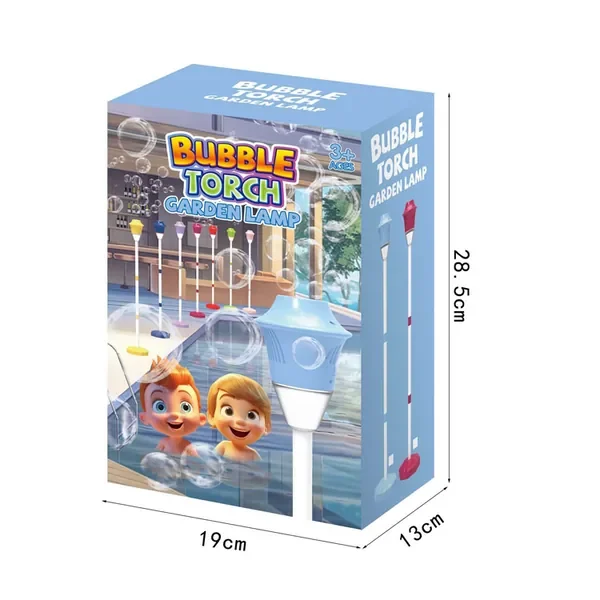
The separate 19 × 13 × 28.5 cm color box creates a useful retail-to-play contrast: compact packaging versus an erected bubble source. Compare the upright format with handheld alternatives at the fair, concentrating on placement and participation rather than lighting alone.
Its box graphic reads Bubble Torch Garden Lamp and marks 19 × 13 × 28.5 cm, matching the retail-pack field. The pictured 3+ age mark is a supplier label. Neither a swimming-pool illustration nor a garden-lamp name proves waterproofing, night-time visibility or safe poolside use. For selection, the concrete distinction is a standing bubble source with a recorded height-adjustment proposition, rather than another handheld character shell.
Your six-reference discovery board
Carry these proposed collection roles into category comparisons. Keep commercial terms and destination-market documentation in a separate follow-up record so the initial hook remains clear.
| SKU | Catalogue form and action | Proposed collection | Reason to investigate | One unresolved question |
|---|---|---|---|---|
| CHT351372 | Written translucent-panel / roof / castle description; exact set to identify | Construction and light-play | A panel contributes to structure and appearance | Which selected pieces support the proposed build and light-play comparison? |
| CHT286411 | TPR sensory chew-rattle configuration | Baby and toddler sensory discovery | Handling connects form to activity | What can the child grasp, move and shake? |
| CHT303813 | Housekeeping accessories; cleaning-themed pretend play | Household role-play | Accessories can support a coordinated activity | What cleaning sequence uses the supplied pieces? |
| CHT265008 | Dinosaur transport truck; car storage and shooting | Interactive vehicles | Storage connects to an action | How does loading lead to shooting, including any powered stage? |
| CHT282855 | Double-sided RC vehicle; driving and rotating flips | Controller-led vehicles | Changing running sides distinguishes the driving proposition | Which control sequence moves the car between running sides? |
| CHT323717 | Standing bubble machine; height adjustment, bubbles, light and music | Outdoor and party play | Placement shapes participation | How do height settings change where bubbles enter play? |
How should you arrange the visit and arrival?
Use the fair’s To Visit entry for registration and choose your approach around your arrival point. covers personal and company details, business-matching categories and purpose, followed by email confirmation after successful registration.
estimates airport-to-Wan Chai journeys at 40 minutes by MTR, 45 minutes by taxi and 80 minutes by bus—not guaranteed door-to-door times. Its Tsim Sha Tsui–Wan Chai ferry example takes 15 minutes.
The venue places Exhibition Centre station, Wan Chai station and Wan Chai ferry pier within a 10-minute walk. Choose the approach first, then organize the visit by your priority play mechanism rather than trying to cover every category.
How do discovery cards become useful business meetings?
Turn the card’s question into the meeting agenda, so the exhibitor knows which mechanism you want to examine. The fair lists for December 11, 2026–February 10, 2027, and Click2Match for January 4–21, 2027, providing digital programme windows around the physical visit.
On site, scans exhibitor booth or product QR codes to open details, save favourites, support chat and enquiries, and access in-person or online meeting scheduling.
Attach the relevant discovery question to the enquiry. A request to walk through loading and shooting, for example, gives the conversation a clearer purpose than an unrestricted catalogue presentation.
Choose your first discovery
Save the discovery board and mark your priority reference. Use its question as the opening brief for your first relevant fair exhibitor enquiry.