Send a SKU-specific brief with the selected toy, artwork status, packaging specification, sample request, tooling changes, quantity, destination and required delivery date. A private-label toy manufacturer needs that written scope to assess feasibility and quote the actual packaging project—not just a box that looks similar. Separate confirmed requirements from proposed options, and request an itemized reply covering MOQ, unit cost, one-time charges, sample cost and schedule. Treat customization capability, ownership terms and timing as project-specific until confirmed in writing.
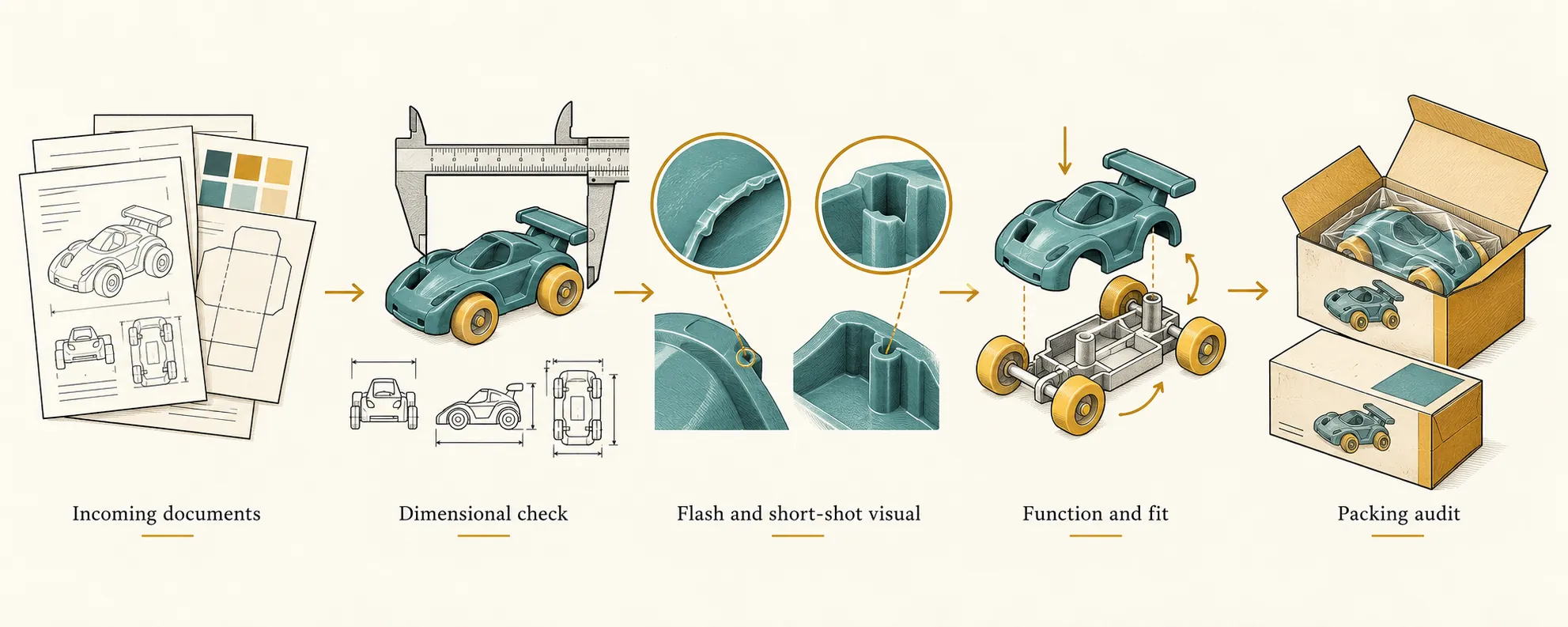
What should the packaging RFQ package contain?
Send one revision-controlled brief with its supporting files, rather than spreading requirements across messages and unmarked images. Quantity, artwork, packaging, destination and sample expectations are useful starting inputs for a custom-toy inquiry. Custom Toy RFQ Checklist
Project identity and product: Give the project name, RFQ revision and date, buyer contact, selected catalog reference and product photos. Identify the exact model, contents and color assortment. State whether the toy itself must remain unchanged; put any product modification on a separate change list.
Quantity and destination: Specify the initial order quantity, quantity per design or color, destination country and delivery address or port. Distinguish a required arrival date from a requested factory dispatch date. Ask the supplier to state the delivery term and which freight or destination charges its price includes. Quantity and color mix can affect MOQ, price breaks and packing work, so do not send only a combined total. Custom Toy RFQ Checklist
Artwork folder: Include the best available logo files, a readable layout preview, approved text, language versions, barcode files and placement references. Mark each file as final or reference-only. State logo dimensions, colors and application location; size, color count and surface shape can affect printing method and sample cost. Custom Toy RFQ Checklist
Packaging specification: Identify the retail box style, whether the existing structure should be retained, proposed dimensions with units, board or material requirements, finish, inserts and product orientation. Attach a marked-up photo if no drawing exists. Include instructions, barcode positions and outer-carton marks. Request the supplier's current dieline—the flat cutting and folding layout—before placing final artwork.
Sample and tooling request: Name the sample needed and what you intend to approve with it. List proposed changes to the box, insert, printing or toy separately. Ask the supplier to identify any cutting dies, printing plates, insert tooling or product molds required, rather than assuming that every packaging change needs a new toy mold.
Destination documents and schedule: List the documents and retailer packaging instructions your purchasing team requires for the selected product and market. Request the submission dates for the dieline, artwork proof, physical sample and production-ready approval. These are quotation inputs, not confirmation that the supplier can meet them.
Which catalog packaging details can anchor the RFQ?
| 38-Piece Magnetic Building Tiles | Supplier-sheet reference: color box; 24 units per carton. Use this as the baseline when requesting a quote to retain the box format or change its structure. |
|---|---|
| 4-in-1 Sensory Baby Toy Set | Supplier-sheet reference: window box; 24 units per carton. Identify whether the request retains the window-box format or proposes a different package. |
| Electric Foam Dart Blaster | Supplier-sheet reference: window box. Confirm current product and package dimensions, including measurement units, before approving a packaging layout. |
Should you request an artwork-only quote or a structural packaging quote?
Request an artwork-only quote when you want to retain the existing package structure; request a separate structural option when the box, window, insert or product arrangement will change. Keeping those scopes separate makes the price comparison meaningful.
For example, the magnetic building tiles have a recorded color-box format and a supplier-sheet case pack of 24. Option A could request replacement brand graphics while retaining the current box dimensions and internal arrangement, subject to supplier confirmation. Send the artwork references and request the current dieline, print specification, sample charge and customized-pack MOQ.
Option B could propose a window box with a revised insert for the same toy. That is a proposed redesign, not a recorded catalog option. Ask for feasibility, a structural drawing, an assembled sample, any tooling charges and a revised carton configuration. Do not carry the original 24-unit case pack into the redesigned quote without confirmation.
Choose Option A if preserving the existing package structure is your priority. Choose Option B only if the window and presentation are explicit requirements and you are prepared to review the additional structural work. Require both replies to use the same toy contents, quantity, destination and delivery basis.
Can you request a quote before artwork is final?
Yes—request an estimated quote using the best available artwork reference, with the assumptions written into the reply. An initial estimate can precede final artwork, but the final proof should be approved before production. Custom Toy RFQ Checklist
Mark unresolved choices directly on the layout: for example, logo placement proposed, finish to be selected or translated text awaiting approval. Ask which changes would trigger repricing or another sample. An estimate based on one print treatment should not silently become approval for another.
Separate artwork from structure in the file names and revision log. A new graphic file does not necessarily authorize a new dieline, and a structural revision needs its own review.
Which sample should you request for packaging approval?
Request an assembled packaging sample with the selected toy when your decision concerns fit, retention and presentation; a loose printed sheet cannot demonstrate those features.
A blank structural sample is useful for reviewing dimensions, folding, closure and product fit, but it does not establish final print appearance. A printed proof supports review of graphics, text and placement; ask whether its material and print process represent production. A logo sample on the toy addresses the application surface, not the retail box.
For a pre-production sample, have the supplier identify the product revision, packaging materials, artwork revision and assembly method it represents. Record any substitutions. These are purchasing checks, not substitutes for applicable product safety testing.
Ask for sample cost, freight, revision charges and timing as separate quotation items. Obtain written supplier confirmation rather than applying general sample-cost or lead-time benchmarks to the project. Toy RFQ Checklist
What must the supplier confirm in its written quote?
Require the supplier to answer against your RFQ revision and state exclusions, assumptions and alternatives explicitly. A price without a defined packaging scope is not ready for comparison.
Commercial basis: Confirm the exact product and packaging revision, workable MOQ for the customization, quantity per artwork or color, current case pack, any order-multiple restriction, currency, unit price, delivery term, payment terms and quote validity. Ask whether mixed designs or colors qualify together or have separate minimums.
Feasibility and one-time charges: Obtain a written response for each requested change. Itemize design or structural development, printing setup, cutting dies, inserts and product tooling where applicable. Ask whether the work will be performed in-house or subcontracted and who is responsible for coordinating it.
Ownership and reuse: Agree who owns buyer-supplied artwork, newly created editable files and any paid tooling. Request terms for storage, reuse, maintenance, transfer and replacement. Payment of a tooling charge should not be treated as a substitute for written ownership terms.
Approval and timing: Confirm the sample type, sample and revision costs, proof sequence, responsible parties and the event that starts each quoted lead time. Ask the supplier to confirm capacity for the proposed order window and distinguish production completion from transit and arrival.
Final pack and documents: Request the retail-pack dimensions, carton dimensions and weight, units per carton, artwork and labeling revisions, and agreed destination-document list. Reconfirm these against the customized package rather than copying them from the original catalog.
How should you compare replies and close open items?
Compare suppliers only after aligning the product, packaging scope, quantity, sample type and delivery basis. Keep estimated or open items visible instead of treating silence as acceptance.
Use one confirmation record for each quotation. Its header should identify the project, supplier, product reference, RFQ revision, quote revision and date, plus the artwork and dieline revisions. For every material requirement, record the buyer's specified target, the supplier's quoted response or sample observation, its status—quoted, estimated or open—and the supporting file or message.
Add the decision and any conditions, the responsible buyer approver and approval date, then assign each unresolved item an owner and due date. Close it with the revised confirmation or sample evidence and a closure date. This creates traceability; it does not by itself verify that later production matches the approved specification.
For example, an artwork-only quotation and a window-box redesign quotation are not competing prices for the same scope. Likewise, a blank-sample charge cannot be compared directly with an assembled printed-sample charge. Ask for an aligned revision before selecting on price.
Do not give unconditional approval while MOQ basis, required sample type, tooling ownership where applicable, or the packaging-proof process remains unresolved. A commercial selection may be conditional on a later final proof, but production release should identify the approved artwork, structure and sample revisions. Send the RFQ brief, attachment index and confirmation record together so every requested change has a checkable supplier response.